
If you searched for “how to start OnlyFans,” you have likely already read several articles explaining how to create an account, upload a profile photo, set a subscription price, and begin posting content. Those steps are technically accurate, and they are necessary. What they rarely explain is that opening an account and building a revenue-generating profile are two completely different things.
Creating an OnlyFans account is simple. Running it as a structured income system is not. Most new creators underestimate this difference, which is why so many pages look active but never produce stable earnings.
OnlyFans is not a discovery platform. It does not promote you, push your content into feeds, or help you build an audience organically. It functions primarily as a payment and access infrastructure. It processes transactions and manages subscriptions, but it does not build your business for you.
Because of that, the real work happens outside the mechanics of the platform. Traffic acquisition, positioning, pricing structure, monetization sequencing, and retention strategy determine whether your effort compounds or stalls. Posting content without that structure often leads to frustration, not growth.
Most guides focus on how to use the platform because that is easy to explain. Far fewer explain how to design a revenue model before you ever go live. The creators who eventually earn consistently are usually the ones who learn this the hard way, after losing months of time experimenting without a plan.
This guide approaches OnlyFans differently. It focuses on the structural decisions that shape your income long before your first subscriber arrives. If you treat OnlyFans as a content hobby, it will pay you like one. If you treat it as a system, it behaves very differently.
Some of what follows may challenge common advice. That is intentional. This industry rewards preparation and exposes improvisation, and the difference between those two approaches becomes obvious by Month 2.
“The OnlyFans platform is not your business. You are the business. The platform is just where transactions happen.” — Top 0.1% Creator |
Before We Start: The Numbers You Need To See
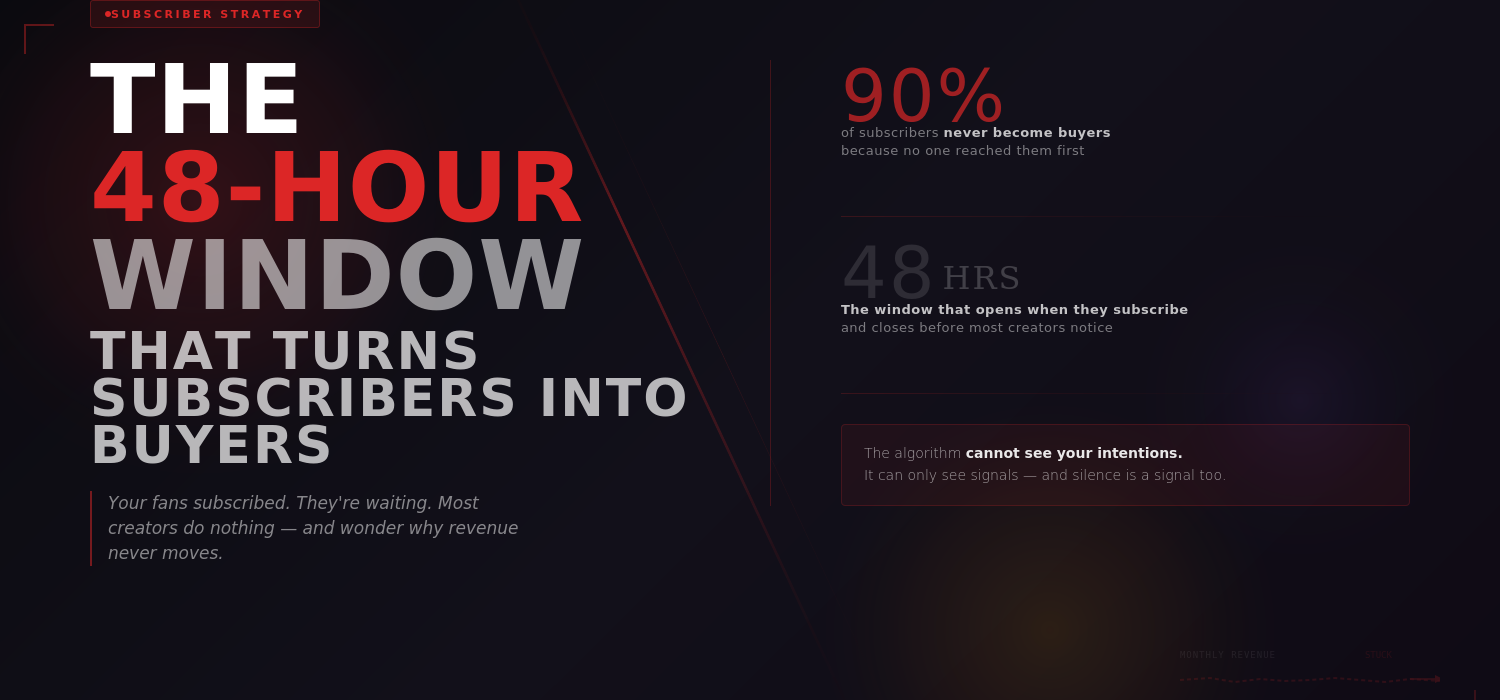
Most articles about starting on OnlyFans skip this section entirely because it is bad for clicks. We include it because starting with false expectations is the number one reason creators quit in the first 60 days. Most creators who skip structure get stuck between $500–$5K.
~73% of creators earn under $1,000/month | Month 2 highest churn and dropout point | 3–6 mo. realistic timeline to stable income | Top 1% earn 33% of all platform revenue |
These numbers are not meant to discourage you. They exist to tell you one very specific thing: most creators fail not because the platform does not work, but because they approach it like a content hobby rather than a structured income system. The creators who earn consistently are the ones who built a system before they posted their first piece of content.
What this guide is not going to do → Promise you $10,000 in your first month → Tell you which type of content earns the most → Teach you photography or video editing → Give you a follower growth hack |
What this guide will do → Walk you through every structural decision before you open an account → Show you how to set up privacy that actually protects you → Help you define your niche and boundaries before subscribers push them → Give you a pricing and content system you can sustain past Month 2 → Tell you exactly when you are ready to go live — and when you are not |
The Decision Layer: Before You Create Anything
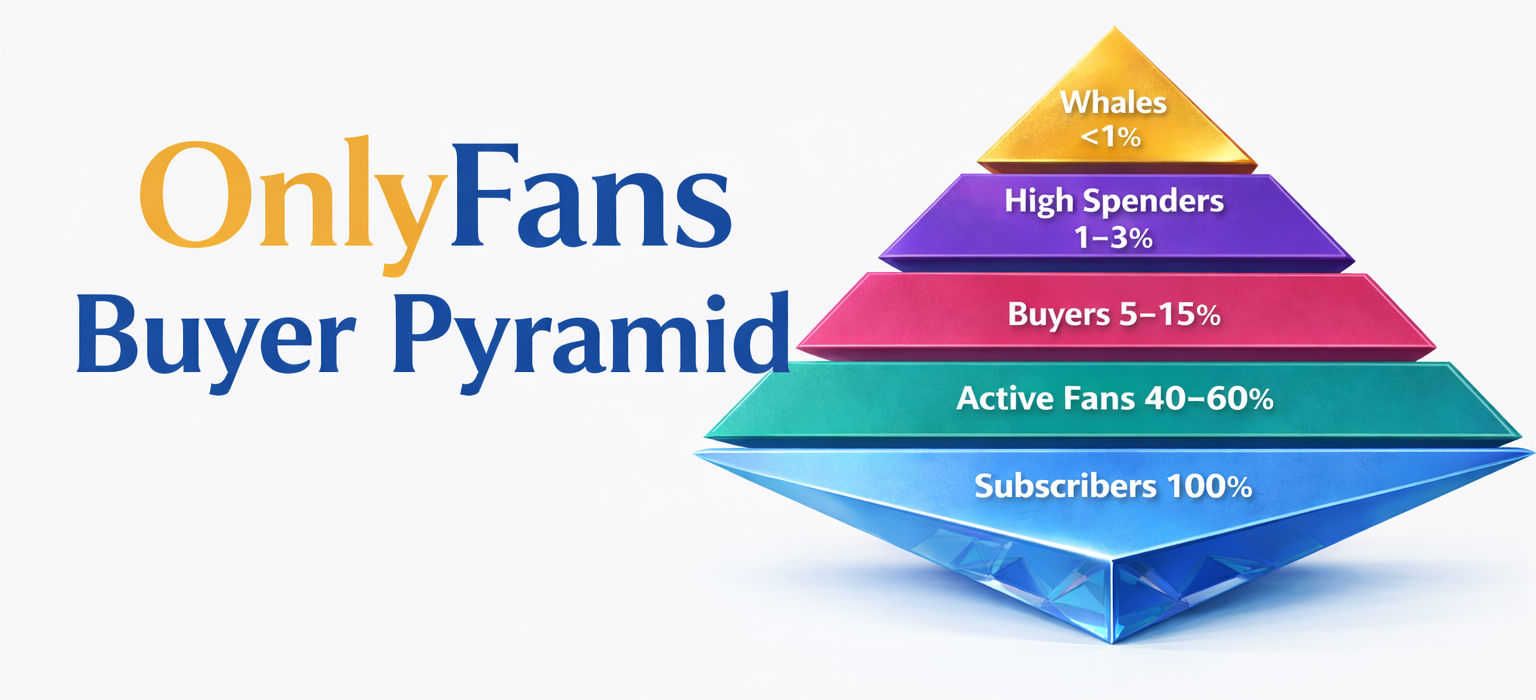
Every creator who has ever said ‘I wish I’d known this before I started’ is talking about this section. These are not platform tasks. They are personal and business decisions that, once made correctly, make every technical step that follows dramatically easier. Its also very important to understand, what is onlyfans buyer pyramid and why most subscribers never buy. This gives you real picture.
Why Do You Actually Want To Do This?
This is not a therapy question. It is a strategic one. Your reason for starting determines how you will behave when things are hard — and they will be hard around weeks 6–10 when growth slows and novelty wears off.
Sustainable Motivations
| Unsustainable Motivations
|
Creators with unsustainable motivations are not bad people. They just tend to quit around Month 2 when the fast money does not arrive – which is almost always right before things would have started working if they had stayed.
Readiness Assessment: Answer These Honestly
Before you invest a single hour into setup, sit with these questions:
- Can you commit a minimum of 8–15 hours per week for 90 days including bad weeks?
- Do you have at least one person in your life who knows what you are doing? (Isolation is the biggest dropout trigger.)
- Are you making this decision from a stable mental place, not from desperation or crisis?
- Do you understand that you will have subscribers who are rude, entitled, or boundary-pushing and can you handle that without a system in place?
- Is there any scenario in which this content being discovered by family, employers, or people from your past would cause serious damage — and have you thought through your plan for that?
If any of the above answers raised a concern, do not skip it. |
Privacy Architecture: Build This Before You Create An Account
Most articles put privacy in a checklist at the bottom. We put it second because everything else depends on it. If your privacy infrastructure is weak, the constant anxiety of potential exposure will degrade the quality of your content and, eventually, push you to quit.
The Separation Principle
Everything related to your creator identity must be completely separated from your personal identity. Not mostly separated. Completely. This means separate infrastructure, not just a different username.
Step 1: Create A Dedicated Email Addres
- Use Gmail or ProtonMail — a brand new account with no connection to your real name
- Your creator name should not appear in the email address, use something generic
- Never access this email on the same browser session as your personal accounts
- Enable two-factor authentication immediately
Step 2: Create A Separate Payment Method
- Open a separate bank account, or at minimum use a separate debit card, solely for creator income. (Not mandatory but recommended)
- Platforms will deposit to this account, your name must appear on it for tax purposes, but it should be functionally separate from your daily banking
- Keep track of all income from Day 1 — platform payments count as self-employment income in most countries
Step 3: Audit Your Existing Social Media
- Check your personal Instagram, Twitter/X, TikTok, and Facebook for any identifying photos that could be cross-referenced with your creator content
- Review your location tagging history, places you post regularly can identify your city or neighbourhood
- Your voice, tattoos, distinctive jewellery, home decor, and background settings can all identify you, decide now which of these will appear in your content and which will not
Step 4: Decide On Your Exposure Level Before You Post Anything
Full Anonymity
| Partial or Full Visibility
|
Neither approach is wrong. The mistake is not deciding before you start then posting partial-face content on impulse and spending the next month anxious about whether someone recognised you.
Step 5: Set Up A Watermarking System
Content theft is common. Your profile will be screenshotted and your content will be shared without your permission, this is not pessimism, it is the reality of the platform. Before you post a single image:
- Choose a watermarking tool (EasyWatermark, Canva, or a simple Lightroom preset)
- Watermark includes your creator name or platform handle — not your legal name
- Place the watermark in a position that cannot be easily cropped out
- Apply watermarks to every piece of content without exception, including content for trusted long-term subscribers
Niche and Boundaries: Define These Before Subscribers Do
This is the section most creators skip because it feels unnecessary before they have any subscribers. It is, in fact, the most important section in this guide — because your niche and your limits will be defined one way or another. Either you define them now, calmly and deliberately, or your subscribers will define them for you through pressure and requests.
“Boundaries set reactively are boundaries set badly. By the time a subscriber is pressuring you in DMs, you are negotiating from a position of discomfort — not clarity.” |
Finding Your Niche: The Overlap Framework
Your sustainable niche sits at the intersection of three things, not just one:
The Three-Part Niche Test 1. What content are you genuinely comfortable producing on a bad week? 2. What is specific enough to attract a defined audience (not ‘general adult content’)? 3. Is there demonstrated subscriber demand for this on the platform? |
The mistake most new creators make is choosing their niche based only on point 3, what seems to earn the most and ignoring points 1 and 2. They start posting content they are not comfortable with, burn out, and quit. Or they start posting everything in hopes of appealing to everyone, attract no loyal subscribers, and quit.
A niche that scores a 10 on comfort and a 6 on demand will outperform a niche that scores a 10 on demand and a 5 on comfort. Consistency beats potential.
Competitor Research: Do This Before You Post
Spend 2 hours looking at the top 10 creators in your intended niche. You are not looking to copy them. You are looking for:
- What do their profiles lead with? (Their hook, their bio language, their pricing structure)
- What seems to be working based on subscriber count vs. price vs. how long they have been active?
- What are they doing that you could not sustain or would not be comfortable with?
- Is there a gap in the niche — something the audience wants that no one is providing well?
That last question is where differentiation lives. A niche of one is more powerful than being the 200th creator doing the same thing.
Defining Your Limits: The Three-Category System
Before you open your account, write down, actually write it down — your content limits in three categories:
Hard Limits
Content you will never produce under any circumstances, for any amount of money, with any subscriber. These do not get negotiated. They do not change based on a nice message or an attractive offer. Write at least 8 specific examples.
Examples: specific acts, involving other people, showing your face if you chose anonymity, location-identifying content, real name disclosure.
Soft Limits
Content you might consider but that requires additional negotiation, a premium price, and explicit pre-agreement. These are not free requests — they are priced specifically because they cost you more psychologically or practically.
Having soft limits does not mean you lack principles. It means you are running a business, not a charity. Deciding the price in advance protects you from being pressured into something for less than it is worth to you.
Standard Content
What you are happy to produce as your regular offering — the content that forms your subscription value. This is what your profile should communicate clearly. Subscribers should know what they are getting before they pay.
Why written limits matter When a subscriber sends an uncomfortable request and you have never written down your position on it, your brain enters real-time negotiation mode. You feel pressure. You might agree to something you regret. When you have a written limit, you already have your answer. You send it confidently because it is not a personal rejection — it is a policy. |
Your Subscriber Conduct Policy
Decide now not in the moment, what behaviour triggers an immediate block. Common policies among sustainable creators:
- Harassment or abusive language in DMs → instant block, no refund discussion
- Chargebacks or false payment disputes → block and report
- Sharing content off-platform → DMCA takedown process, reported to platform
- Repeated requests after a stated no → warning then block
Write a two-sentence response you can copy-paste for limit violations. Having it ready means you do not have to compose it while already feeling uncomfortable.
Platform Setup: Now You Can Create Your Account
Notice that this section is fourth, not first. Everything before this point had to be decided before you touched the platform. If you started here and are reading backwards go back. The decisions in Sections 1–3 will determine whether your setup in Section 4 is built on solid ground or sand.
OnlyFans vs. Fansly: The Actual Comparison
Most guides recommend OnlyFans by default because it is the better-known platform. That is not a good enough reason to choose it. Here is a practical comparison:
OnlyFans → Larger existing subscriber base → Better brand recognition — subscribers know what it is → More established payment infrastructure → 20% platform fee on all earnings → Stricter account verification process → No built-in discoverability — you must drive your own traffic → Free and paid account options | Fansly → Smaller but growing subscriber base → Built-in discovery feed — can attract organic subscribers → More flexible content tier system → 20% platform fee on all earnings → Faster and often smoother account approval → Better suited for creators who want tiered subscription access → Growing credibility with creators leaving OnlyFans |
The recommendation: start with one platform. Running both simultaneously as a new creator splits your attention and your content production before you have a system in place. Master one, then expand.
If you have no existing audience, Fansly’s discovery feed is a meaningful advantage in your first 60 days. If you have an existing social media following you can redirect, OnlyFans brand recognition works in your favour.
Profile Setup: What Actually Matters
Your profile is not decoration. It is a sales page. Every element should answer one question for a potential subscriber: why should I pay for this specific account rather than any other?
Profile Photo
- High quality, well-lit, represents your niche clearly
- Consistent with the content you will produce, if your content is anonymous, do not show your face in the profile photo
- Not a phone camera selfie in bad lighting — first impressions determine whether someone reads your bio
Bio – The Most Underused Real Estate On The Platform
Most creator bios say something like ‘Welcome to my page! Subscribe for exclusive content.’ That tells a potential subscriber nothing that differentiates you from 2 million other accounts.
A strong bio answers four things in under 60 words:
- What specifically do you offer? (not ‘content’ — what type, what tone, what frequency)
- What makes your page different from similar creators?
- What does a subscriber get for their monthly fee?
- What is your communication style with subscribers?
Weak bio example “Hey! Welcome to my page, so happy you’re here 🥰 Subscribe for exclusive photos and videos, lots of fun content updated regularly! DMs open!” |
Strong bio example “Cosplay and fantasy content, updated 4x per week. High quality sets, no rush, no fillers. PPV available for custom themes. DMs answered within 24hrs. Serious subscribers only — this is a professional page.” |
Cover Image
- Not optional — a blank or generic cover signals an inactive or low-effort account
- Should hint at your niche without violating platform preview rules
- Canva has free templates — spend 20 minutes on this, it is visible before someone subscribes
Verification
Both platforms require government ID verification. This is non-negotiable and cannot be bypassed. Your legal name and ID are stored by the platform but not visible to subscribers, your persona name is what they see. Do not attempt to use someone else’s ID. Accounts discovered doing this are permanently banned.
Pricing: The Decision That Determines Your Business Model
Pricing is where most new creators make their most costly mistake — and it is almost always the same mistake: they charge too little because they are not confident, then attract subscribers who expect maximum effort for minimum pay, then burn out trying to over-deliver at an unsustainable rate.
“Your subscription price is not just a number. It is a signal about the quality and seriousness of your page. Low prices attract high-maintenance subscribers.” |
Subscription Pricing: The Framework
Do not set your price based on what you think you are worth emotionally. Set it based on your niche positioning and what comparable creators in your space charge.
A practical starting framework:
- Research 10 creators in your niche — note the range of subscription prices
- Position yourself in the middle third of that range as a new creator, not at the bottom
- Decide now: are you a subscription-forward model (revenue from monthly subs) or a PPV-forward model (lower sub price, higher revenue from individual content purchases)?
- Neither is wrong – but you need to choose a primary model and build your content strategy around it
The underpricing trap Setting a $3/month price might attract more subscribers. But $3 subscribers expect the same content and DM attention as $15 subscribers, and they churn faster because they have no financial commitment to the page. Sustainable creators almost universally report that raising their price reduced churn and increased revenue simultaneously. |
PPV (Pay-Per-View) Structure
PPV is where many creators generate the majority of their income. It needs a structure before you start, not figured out request by request.
- Decide on 3–5 standard PPV price points in advance (e.g. $8 for a short video, $20 for a long video set, $40 for custom content)
- Your PPV price should reflect production time, uniqueness, and your limits — custom content that pushes toward your soft limits should be priced meaningfully higher than standard content
- Do not negotiate PPV prices downward in DMs — it sets a precedent that your prices are not real
- Mass PPV messages to all subscribers should be sent on a schedule, not randomly
Tip Menu
A tip menu tells subscribers exactly what they can request and what it costs. This eliminates awkward DM negotiations and makes it easy for subscribers to spend money on your page. Post it as pinned content. Minimum five items, ranging from small (a personalised shoutout or a photo) to large (extended custom content).
Content Systems: Build The Machine Before You Turn It On
The moment you go live, the clock starts. Subscribers who find an empty or sparse profile will not wait. They will unsubscribe. This means you need a content bank — a stockpile of produced content – before you publish anything.
The Pre-Launch Content Bank Rule
Do not go live with fewer than 15 pieces of content ready to post. This is not arbitrary – it covers you for your first three weeks of posting at 5 pieces per week without having to produce anything new while you are also managing subscribers, DMs, and the mental adjustment of being live.
Why creators who launch with empty profiles fail A subscriber who arrives on Day 1 and sees 2 posts will not subscribe. Or they subscribe, see nothing new for a week, and cancel. A subscriber who arrives and sees 20 posts, then gets new content 4-5 times per week, has a reason to stay. They are consuming a backlog while you keep adding. That is retention. |
Your Weekly Content Schedule
Design your posting schedule around your worst week, not your best week. If you commit to 5 posts per week, you need to be able to hit that in a week when you are sick, stressed, or busy. If you cannot, commit to 3.
Sustainable posting beats ambitious posting that collapses. Subscribers who see consistent delivery at a moderate pace retain at higher rates than subscribers who see an intense burst followed by two weeks of silence.
Build a simple content calendar — a spreadsheet or even a paper notebook — that shows what is posted and what is scheduled for the next 30 days. Having 30 days planned in advance means you produce with intention, not panic.
Batching: The Sustainability Secret
Professional creators do not produce content every day. They batch. Once or twice a week they produce a large volume of content that covers the next 7–14 days of posting. This has several advantages:
- You are in ‘creation mode’ only during scheduled sessions — not performing on demand every day
- Content quality is more consistent because you are not producing in whatever mood happens to arrive each morning
- You build a buffer — if you have a bad week personally, your content schedule does not know about it
- You can plan thematically — a week of content with a cohesive aesthetic or narrative is more engaging than random daily posts
The Soft Launch vs. The Hard Launch
Most guides tell you to go live and start promoting immediately. We recommend a different approach for your first two weeks.
Soft Launch (Weeks 1–2) Profile is live but not heavily promoted → Upload your content bank → Test your DM response workflow → Refine your bio based on what questions come in → Test your PPV messaging flow → Learn the platform’s posting tools without pressure | Hard Launch (Week 3 onwards) Active promotion begins → Traffic from Reddit, Twitter/X, or other platforms → Posting on promotional accounts → Collaborations or shoutouts with other creators → Actively driving subscribers to a page that is ready |
The two-week soft launch is not wasted time. It is the difference between sending traffic to a polished, active, responsive page – and sending traffic to a page that then disappoints them.
The First 30 Days: What To Focus On And What To Ignore
Your first 30 days are a data collection period, not a performance period. The number on your revenue dashboard at Day 30 is less important than what you learn about your subscribers, your content, and your systems during those 30 days.
What To Focus On
✓ Consistency — post on your schedule without exception
✓ DM response time — reply to all messages within 24 hours during Month 1
✓ PPV testing — try at least 2 different price points and note the conversion rate
✓ Subscriber feedback — what content do people comment on, tip on, or message about?
✓ Churn tracking — note when subscribers cancel and how long they stayed
What To Ignore In Month 1
✗ Total subscriber count — one subscriber who stays for 6 months is worth more than 20 who stay 3 days
✗ Comparing your revenue to other creators online — you are seeing their highlight reel, not their Month 1
✗ Algorithm theories and growth hacks — you do not have enough data to optimise yet
✗ Adding a second platform — wait until Month 3 when your system is working on Platform 1
The Month 2 Churn Problem
This is the single most predictable failure point in creator careers, and almost no ‘how to start’ guide addresses it properly.
Month 2 churn is the wave of subscribers who cancel after their first renewal. They subscribed in Month 1 because something caught their attention. If your Month 2 content does not reinforce that decision, they leave. The fix is structural, not creative:
- Plan a specific Month 2 content hook before you launch — something your existing subscribers get as a reward for staying (a themed content series, exclusive access, a direct message milestone)
- Send a mass message to subscribers around Day 25 teasing what is coming in Month 2 — give them a reason to renew before they think about cancelling
Review your churn data weekly: if a specific type of subscriber is leaving quickly, that tells you something about your pricing, your content, or who you attracted in the first place
Tracking & Measurement: Running This Like A Business
This section is where most creator guides end their involvement entirely. It is also where most creator businesses start failing silently — because you cannot fix what you are not measuring.
The Minimum Viable Tracker
You do not need complex software. A spreadsheet with the following fields, updated weekly, is enough to run a structured creator business:
Metric | Why It Matters | What To Do With It |
New subscribers this week | Shows if traffic strategy is working | If flat: test a new traffic source |
Cancellations this week | Shows retention health | If high: review content quality and posting frequency |
Subscription revenue | Baseline income | Track trend week-over-week, not just total |
PPV revenue | Shows if monetisation flow works | If low: test different price points or send more PPV messages |
Tips received | Signals high-satisfaction subscribers | Note what content preceded each tip |
DMs received / sent | Engagement level indicator | High DMs with low PPV = engagement not converting to revenue |
Churn rate % | Cancellations ÷ total subscribers | Above 20% monthly: investigate what Month-2 content is missing |
The Honest Summary
Starting on OnlyFans or Fansly is not complicated. The platform mechanics take a few hours to learn. What takes longer — and what determines almost entirely whether you succeed — is the structural foundation you build before you go live.
Creators who build that foundation — who decide their limits, set up their privacy, define their niche, build their content bank, and establish their pricing before posting a single piece of content — have a fundamentally different experience than creators who sign up on impulse and figure it out as they go.
The second group is not less talented. They are just less prepared. And in a business where Month 2 churn kills most accounts before they find their rhythm, preparation is the only sustainable advantage.
“Revenue plateaus are operational failures – not content failures. The creators who break through are the ones who treated this like a business from Day 1.” |